Who are ‘New.Hedonists’ and why should brands embrace them?
This article looks at how hedonism is changing. And specifically, what it means for younger generations like Gen Z, aka New.Hedonists.
As hedonism has changed, brands need to understand how Gen Z engages with specific categories —what they value, need, and how these shape their behaviours – as they try to capture the potentially lucrative Lifetime Customer Value Gen Z offer.
How we understood Hedonism’s changing nature
The Myth: Gen Z = Anti-hedonistic
Before we start to explore what hedonism means to Gen Z, we need to take a step back and tackle a well-established myth about Gen Zers – that they’re ‘anti-hedonistic’.
This belief has spread through boardrooms, agencies, and media outlets like Japanese knotweed.
This viewpoint is partly driven by the dramatic drop in alcohol consumption by Gen Z. Compared to Millennials across 7 days, 45% of Gen Z drink less in the UK, whilst 35% drink less in the US. (Youth drinking in decline: John Holmes et al, 2022)
No one can question these numbers; they represent a significant drop in alcohol consumption.
Couple this with Gen Z’s thriftiness where 40% believe it’s “fundamental” to save for their future – and over a third had £1k in savings to dip into way back in 2019 (Zopa, UK, 2019)
Naturally, to enable them to save, often this means cutting back on life’s hedonistic luxuries, such as going out to clubs, bars, or restaurants.
So, you can understand why many buy into the belief that Gen Z is ‘anti-hedonistic’.
The Fact: Gen Z = most hedonistic generation of all time
However, at Shape Insight, we’ve conducted too many qualitative interviews and analysed too much data, that all indicate that Gen Z are as much into hedonism as previous generations (although, for confidential reasons, we can’t tell you those findings).
But dig around online, you can unearth some significant (and robust) studies that also tell the same narrative.
BCW’s report – Age of Values 2023, one of the largest studies of its kind, was based on Prof Shalom H Schwartz theory of basic human values. Running in 2023, surveying 36,000 people in 30 countries, they wanted to understand how values vary by generational cohort.
Focusing on the value of Hedonism, their results showed that 43% of Gen Z said it was “important to them to do things that can give them pleasure” (vs. 38% Millennials, 27% Gen X).
In addition, they also learned that 44% of Gen Z say they “wanted to live an exciting lifestyle” (vs. 32% millennials, 20% Gen X).
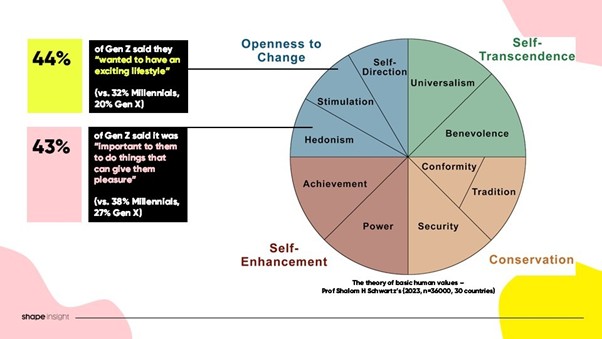
BCWs report – Age of Values 2023 – Findings, via some big numbers, BCWs work demonstrates that Gen Z sees hedonism as an important value to live by, but in fact, they’re the most hedonistic generation on record!
Our Mission
As naturally curious people at Shape Insight, we wanted to go deeper. We wanted to holistically understand what hedonism means to Gen Z. We also wanted to be able to share our learnings with others.
Through a one-off study, we set out to find answers to the following questions:
- What does hedonism mean to them (values)?
- How does it manifest itself in their everyday life (actions)?
- Is there anything that holds them back (concerns)?
- And what things do they use to ‘fuel’ their hedonism (tools)?
To find answers to these questions, we turned to Moments
We recruited the following people:
- n=200 Gen X
- n=200 Millennials
- n=200 Gen Z
…and got each person to tell us a variety of real stories about what hedonism means to them, both looking into the past, but also exploring what it means to them today
Moments then compared and contrasted different generations approaches to hedonism to see how Gen Z’s approach is different.
What we found out
As we alluded to at the start of this article, Gen Z’s approach to hedonism is different.
A succinct way to summarise it = previous generations’ approach to hedonism was ‘simplistic’ and ‘binary’, whilst Gen Z’s approach is ‘rich’ and ‘complex’.
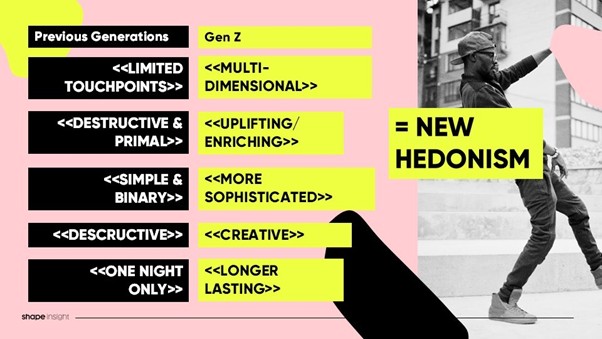
Without digging into each of the above themes in detail, it’s clear to us that brands need to change the way they think about hedonism – at both a brand and product level.
To help you navigate this change, we’ve created the below cheat sheet that outlines all our key insights across our original objectives. Use this tool as a way to challenge what you’re currently working on and how it should be positioned.