Travel experiences – the future of travel
To give the brands we collaborate with a strategic edge this summer, Shape Insight surveyed 2,000 UK travellers who took a holiday of at least five nights in 2024 and plan to travel again this year. The findings reveal a projected £45 billion in summer vacation spend, highlighting a major opportunity for engagement.
Our research has also found that £22bn is spent on experiences alone (think meals, sports events etc). Travel experiences are, without question, the future of travel. And it’s not just us who say so:
- McKinsey & Company believe that travel experiences are a $1 trillion dollar opportunity
- HBX Group have found that experiences now drive destination choice
- The CEO of Airbnb believes there is an opportunity to create a $100 billion company
So why do brands, and ironically, specifically travel and hospitality brands fail to fully capitalise on travellers’ appetite for travel experiences?
Let’s explore some of the current missed opportunities and what steps these brands can take to capitalise on them.
Travel experiences are sold predominantly to affluent travellers
Currently, ‘travel experiences’ are often exclusively marketed to more affluent travellers – driven by high-end travel companies such as Audley Travel, Abercrombie & Kent and Quintessentially. And it makes sense. If you’re looking to sell a £14,000 safari in Kenya, it’s an easier ‘sell’ if your end target has an assumed high disposable income, right?

However, our research has found that the appeal of travel experiences transcends demographics and socio-economic backgrounds. Over half of Gen Z travellers we surveyed are prepared to pay an estimated £1500 on just experiences whilst away on their summer holidays.
Whilst this might sound like a small amount in comparison to £14,000 on safari in Kenya, the value lies in the economy of scale. There are currently 7.8 million Gen Z in the UK alone who are 18+. Even if just 15% of this total spent a couple of hundred pounds, it would yield a brand a significant return on investment.
Opportunity: For a brand like Jet2holidays, this presents a huge opportunity as they’re already selling package holidays to Gen Z (i.e. flight & accommodation). Why not take it a step further and provide Gen Z travellers with a range of tailored experiences they can tap into whilst they’re booking their trip?
This could be tickets to a concert, a matchday experience at one of the country’s top football teams, or perhaps a one-day excursion to a neighbouring town with a wide range of activities already planned.
Brands target only one type of travel experience
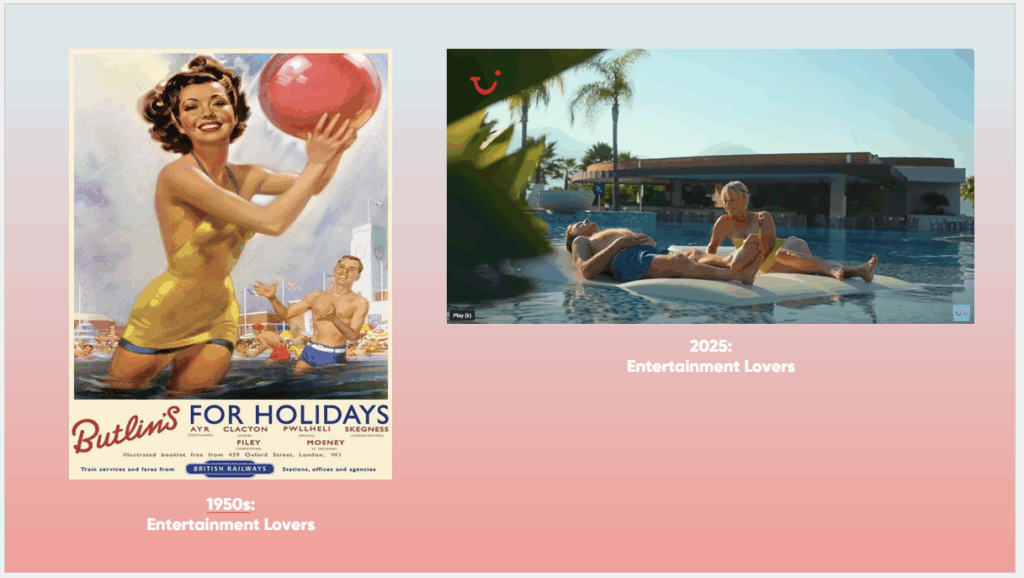
Since the birth of package holidays, travel and hospitality brands have focused on a single travel experience to ‘sell holidays’ – i.e. it’s all about ‘Entertainment’! This approach has remained true for over 75 years, as shown by comparing and contrasting an advert from Butlins from 1950 and more recently TUI this year.
However, this approach relies on 2 incorrect myths:
- The idea that during our summer holiday, we do the same thing day in and day out
- That groups of travellers (e.g. families) want the same thing
To debunk these myths, we leaned into Pine and Gilmore’s Experience Economy model. From this, we’ve been able to develop four summer holiday experiential mindsets:
- Entertainment Lovers
- Learning Enthusiasts
- Immersive Explorers
- Adventure Seekers
This then allows us to understand that whilst a key mindset drives their initial booking, other types of experiences speak to them. As shown below, for a ‘Learning Enthusiast’, whilst their dominant mindset is ‘Education’, having an ‘Esthetic’ experience is also important to them during their trip.
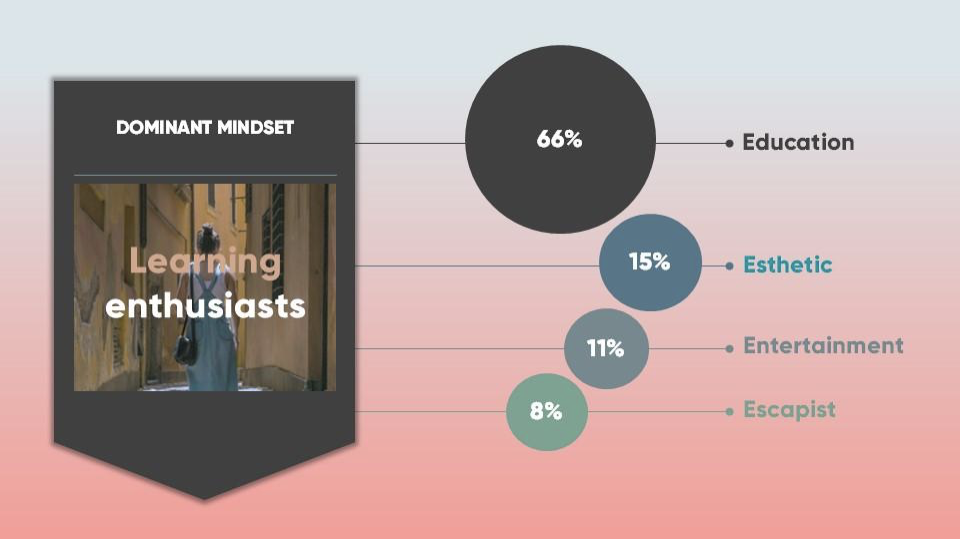
But herein lies the challenge – can a hospitality or travel brand genuinely deliver against these diverse needs? No. This is because of the Gold Dilution Effect – in short, the more you do, the less credible you become.
Opportunity: But there is a way to overcome the ‘Gold Dilution Effect’ – brand Collabs. For many cohorts, ‘brand authenticity’ is important. This means it’s better for a brand to partner with another brand that has genuine credibility within a specific sector/ area, versus pretending they’re able to deliver it.
Collabs are also a great way for brands to tap into demographics that may not have been aware of their brand. If you’re looking for inspiration, collabs by Airbnb x Barbie or Amex x Uber are great examples of how to do this.
The value of ‘in the moment’ experiences
Our data also shows that over 50% of our 2,000-sample book their summer holiday 6 months in advance. However, we’ve also learnt that early booking behaviour is defined by securing airline tickets and hotel reservations, and very little else.
Most travellers arrive at their destination with a vague idea of what they will do (unless travelling on an organised holiday), but truth be told, nothing is locked in.
Opportunity: There is a significant opportunity for hotel brands such as IHG, Hilton and Marriott to capitalise on this tardiness and empower ‘in the moment’ experiential booking.
For example, a traveller wakes up one morning and wants their culture fix. They log into their hotel app and ask their AI assistant to build them a detailed itinerary of what to do, what to see, and where to eat – from breakfast to dinner time. Each one of these suggestions is linked to the hotel brand either by being sub-brands or suppliers who are levied a charge to be part of the ‘chosen’ group of suppliers.
Better still, this behaviour is ingrained in us humans due to loss aversion and present bias.
Don’t miss your opportunity
With summer in full swing and holidays largely locked in, the focus now turns to the experiences that define them. There’s still time to tap into travellers’ in-the-moment appetite, but if that window closes, 2026 beckons. With projected spend rising to £23.1bn, now is the moment to consider how your brand will shape future travel experiences. It’s an opportunity well worth the investment.